Private label vs OEM vs ODM wearables: what is the difference?
"OEM", "ODM" and "private label" are used loosely in the wearables industry, and the difference matters: it decides how much you invest, how long it takes and how unique your product is. Here is a plain explanation.
Quick answer: private label puts your brand on an existing model (from 500 units, about 30 days after sample approval); OEM goes further with your own finishes, colors, language set and packaging on a proven platform; ODM develops a new product to your brief, with MOQ and payment terms set per project.
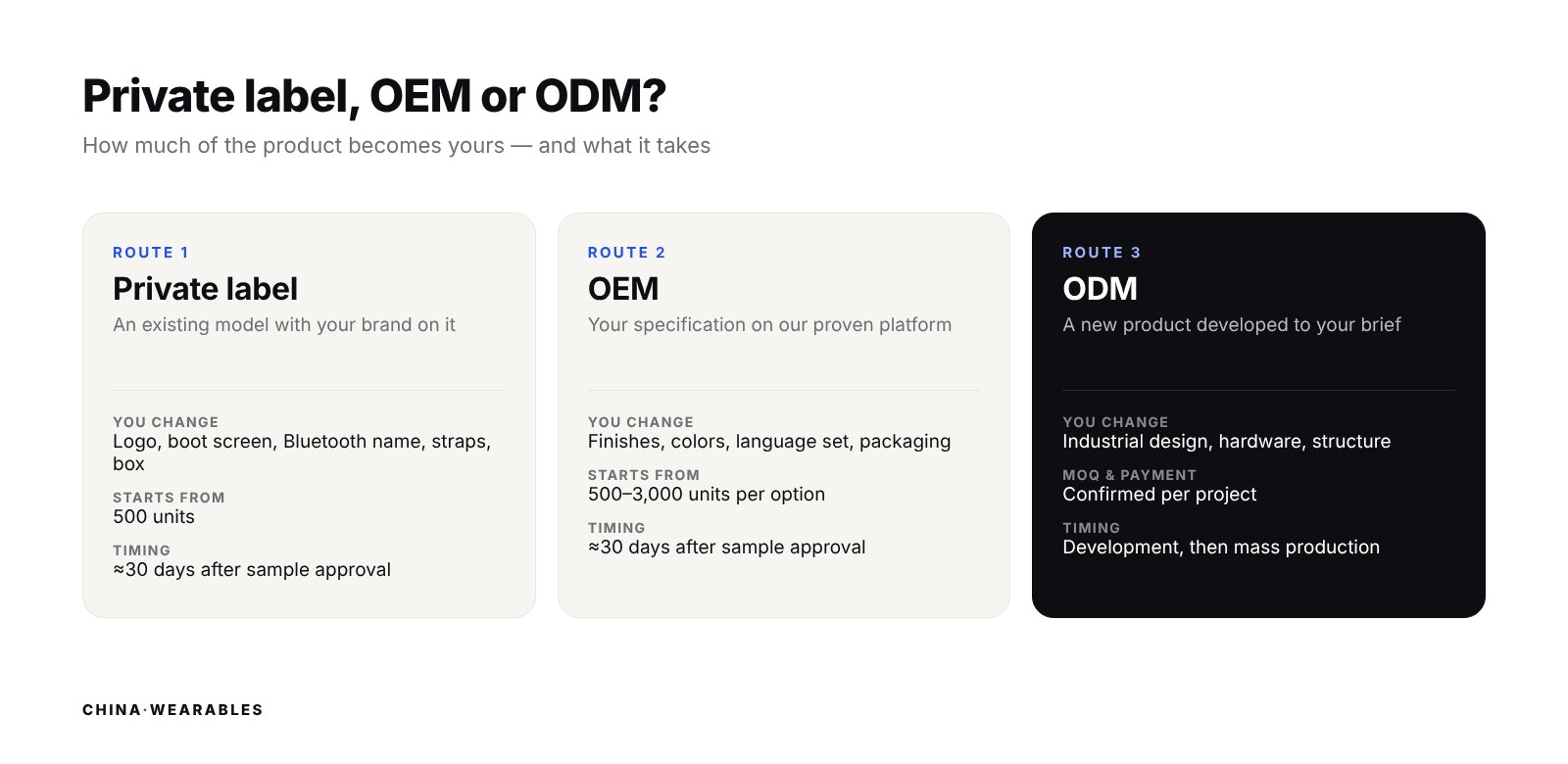
| Private label | OEM | ODM | |
|---|---|---|---|
| What changes | Logo, boot screen, Bluetooth name, straps, box | Finishes, colors, language set, packaging | Industrial design, hardware, structure |
| Starting MOQ | 500 units | 500–3,000 units, by option | Confirmed per project |
| Typical timing | About 30 days after sample approval | About 30 days after sample approval | Development stages, then about 30 days of mass production |
| Best for | Fast, low-risk launch | A distinct look on proven hardware | A product no existing model covers |
Private label: an existing product with your brand
With private label, you start from a model the factory already makes and put your brand on it. The hardware, sensors and app platform stay the same; what changes is everything your customer sees and touches:
- Your logo, silk-screen printed or laser-engraved on the strap or case (from 500 units)
- Your startup logo and Bluetooth name (from 1,000 units)
- Your choice of strap materials, colors and finishes (custom nylon straps from 2,000 straps)
- Additional UI languages and manuals (from 3,000 units)
- Your own color retail box (from 3,000 units)
Best for: brands and distributors who want to launch quickly with low risk. The product is already proven in mass production, samples are available right away, and customized orders run about 30 days after sample approval.
OEM: your specification, built on the factory's platform
In OEM work you go a step further and specify how the product should look and behave for your market — finishes and color matching per model family, decorative options, language set and packaging — while the factory's existing platform provides the electronics and production process. In practice, many projects sit between private label and OEM: the more of these elements you define, the more the product becomes distinctly yours.
Best for: brands with a clear design direction that still want proven, certified hardware underneath.
ODM: a product developed for you
ODM (original design manufacturing) means the factory develops a new product to your brief — from the industrial design to the hardware and the mechanical structure. It offers the most differentiation, and every ODM project is scoped and quoted individually.
We take on ODM projects and support you with product design, hardware development, structural development, manufacturing and test validation. The app and cloud platform are usually developed by the brand itself, to fit its own needs.
Typical ODM timeline
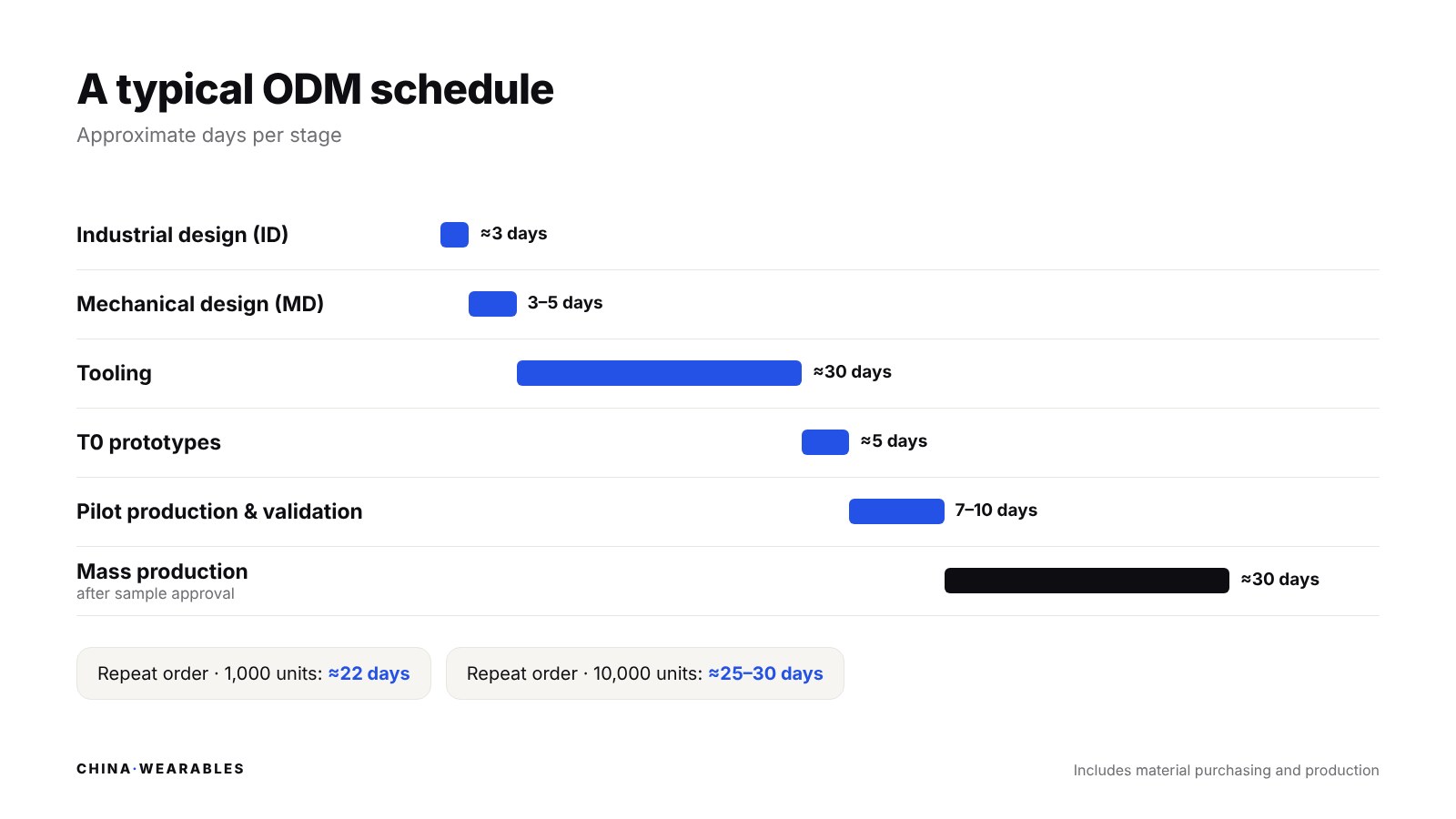
- Industrial design (ID): about 3 days
- Mechanical design (MD): about 3–5 days
- Tooling: about 30 days
- T0 prototypes: about 5 days
- Pilot production and validation: about 7–10 days
- Mass production after sample approval: about 30 days
The schedule for the first production run is confirmed as the project moves through these stages. After that, repeat orders of 1,000 units take about 22 days, and 10,000 units about 25–30 days, including material purchasing and production.
MOQ and payment terms for ODM depend on the final design, configuration and order quantity, and are confirmed with you per project.
Best for: established brands with a specific product idea that no existing model covers.
FAQ
What is the difference between OEM and ODM?
In OEM you specify the look and features on a product platform the factory already has. In ODM the factory designs and develops a new product to your brief, from industrial design to hardware and structure.
What is the MOQ for a private label smart band?
Logo printing or laser engraving starts at 500 units; a custom startup logo and Bluetooth name at 1,000 units; custom nylon straps at 2,000 straps; an additional language or a custom color box at 3,000 units.
How long does an ODM smart band project take?
Industrial design takes about 3 days, mechanical design 3–5 days, tooling about 30 days, T0 prototypes about 5 days and pilot production 7–10 days. Mass production then takes about 30 days after sample approval.
Do you develop the app and cloud platform?
We handle product design, hardware, structure, manufacturing and test validation. The app and cloud platform are usually developed by the brand itself.
How to choose the right route
- Start from your timeline. If you need product on the shelf this season, private label on an existing model is the realistic route.
- Check what already exists. Our range covers 22 models — screenless bands, ECG and AI wearables (including the ES100 AI voice-recorder band), fashion bracelets, couples' models and smart quartz watches. Often the product you have in mind is one finish or one strap away from a model that is already in production.
- Think about certification. Our existing products hold CE, FCC and RoHS certification, along with nickel-release testing, CE battery and IEC 62133 battery safety, UN38.3 transport reports and design patents — ask us for the exact documents per model. A brand-new ODM design needs its own testing.
- Grow in steps. Many partners begin with private label, learn what their customers want, and then move to deeper customization for the next generation.
One more thing: talk to the factory directly
Ask any supplier whether you are talking to the factory or to a trading company. With us you deal directly with the factory: one sales contact for pricing, samples, production and shipping, and fast, first-hand answers on what can be customized.
See every customization option on our OEM & ODM page, browse all models, or tell Leo about your project.