Smart band housing materials: zinc alloy, stainless steel, aluminum or plastic?
The housing is the first thing your customer touches, and it decides more than the look of a smart band: it affects which colors you can offer, how complex the shape can be, how long tooling takes and even whether Bluetooth and NFC work properly. Here is what brands should know about the four materials used most often: zinc alloy, stainless steel, aluminum alloy and plastic.
Quick answer: choose aluminum alloy or plastic if you need a specific brand color, zinc alloy or plastic if you need a complex shape, and always keep a non-metal area for Bluetooth — and a metal-free contact area if you need NFC.
| Material | How it is colored | Color range | Complex shapes | Signal passes through |
|---|---|---|---|---|
| Zinc alloy | Electroplating | Limited (black, golds, blue) | Yes | No |
| Stainless steel | Electroplating | Limited (black, golds, blue) | No — stamped | No |
| Aluminum alloy | Anodizing | Wide and stable | No — CNC machined | No |
| Plastic | Spray painting, UV, soft-touch coating, plating | Wide | Yes | Yes |
Why a smart band can't be all metal
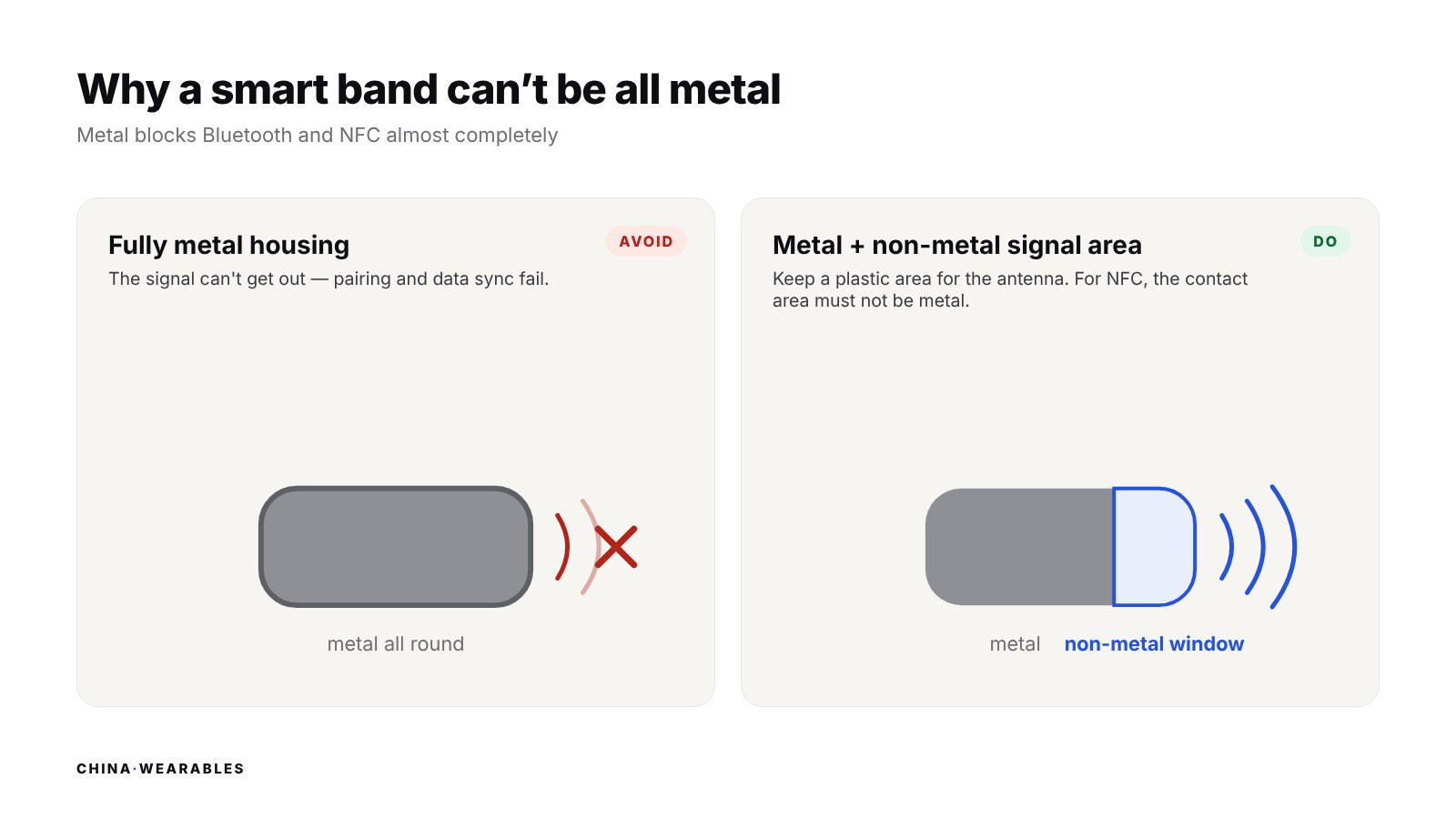
Metal blocks wireless signals almost completely. A band needs Bluetooth to talk to the phone, so electronic products are generally not made with a fully metal housing — part of the case has to let the signal through.
This matters even more for NFC. If you plan an NFC version (for example for payments or access cards), the area where the signal is read must not be metal. Tell us early in the project so the design keeps that contact area free of metal.
Zinc alloy and stainless steel: plated colors
Zinc alloy and stainless steel housings usually get their color from electroplating. The common plated colors are:
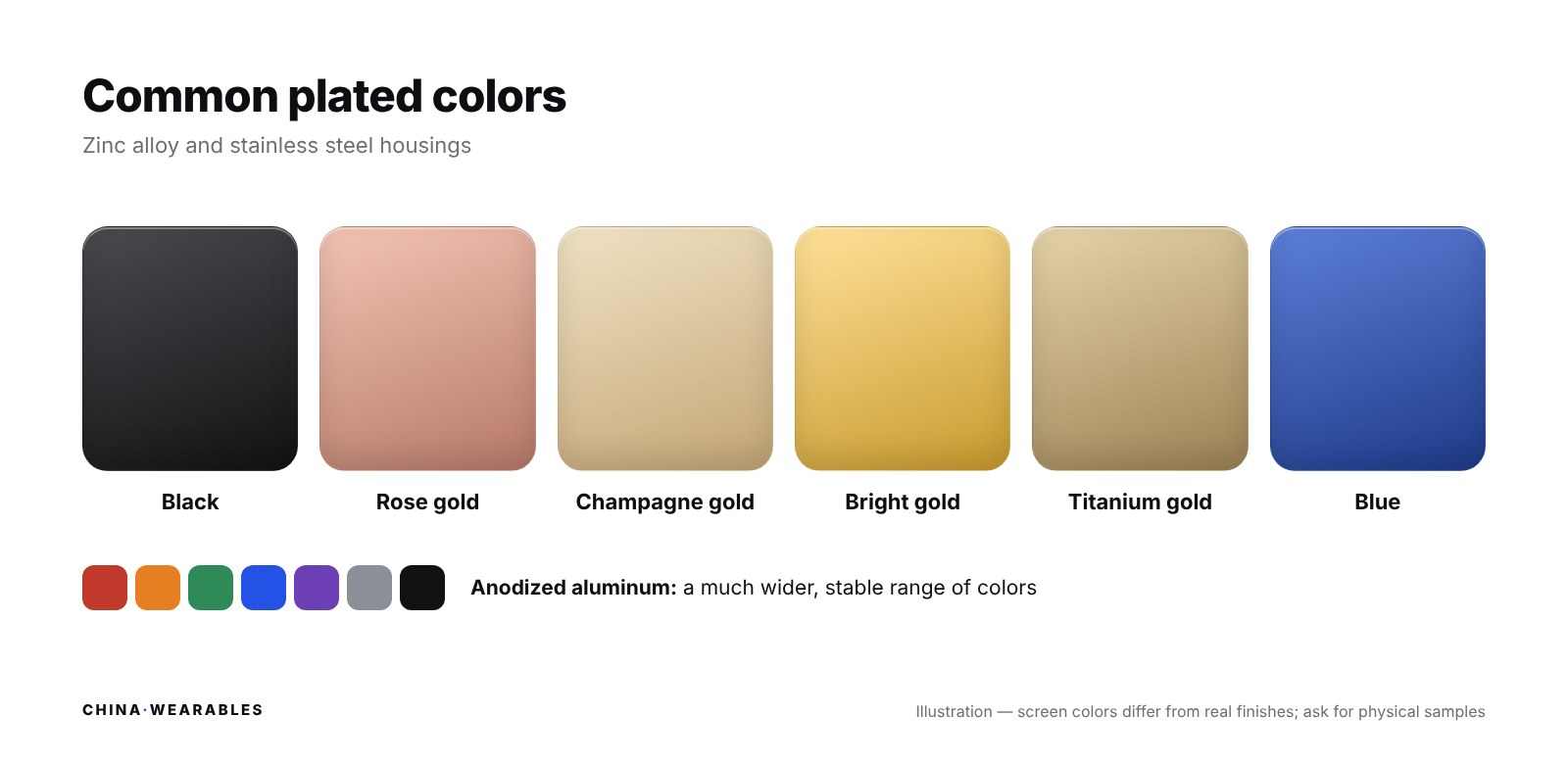
- Black
- Rose gold
- Champagne gold
- Bright gold
- Titanium gold
- Blue
Plating has real process limits: many colors are very difficult to plate consistently. If your brand color is not on the list above, ask before you design around it.
Aluminum alloy: almost any color
Aluminum alloy is colored by anodizing. Anodizing can produce a very wide range of colors, and the color is stable. If a specific brand color matters to you, aluminum is usually the easiest metal to match it on.
Plastic: the most finish options
Plastic housings offer the widest choice of surface finishes:
- Raw material, with no extra finish
- Spray painting
- Glossy UV coating
- Matte UV coating
- Soft-touch coating
- Electroplating
Plastic also lets the wireless signal through, which makes it the natural choice for parts of the housing near the antenna or an NFC area.
Shape and tooling: what each material can do
If you are developing your own housing (an ODM project), the material also decides how complex the structure can be:
- Zinc alloy and plastic can be molded into complex structures.
- Aluminum alloy housings are mainly made by CNC machining. A complex structure means very high labor cost and a long lead time, so aluminum suits simpler shapes.
- Stainless steel housings are formed by stamping, which also limits them to simpler structures.
FAQ
Does a metal case block Bluetooth?
Yes. Metal blocks wireless signals almost completely, so a smart band needs a non-metal area for its antenna.
Can a metal smart band have NFC?
Yes, as long as the NFC contact area is not metal. Plan this at the start of the design.
Which housing material offers the most colors?
Anodized aluminum alloy offers a wide, stable range of colors. Plated zinc alloy and stainless steel are limited to colors such as black, rose gold, champagne gold, bright gold, titanium gold and blue.
Which material suits complex shapes?
Zinc alloy and plastic can be molded into complex structures. Aluminum alloy is CNC machined and stainless steel is stamped, so both suit simpler shapes.
How to choose
- Start from your brand color. Need an exact color? Look at anodized aluminum or plastic. Happy with black, gold or blue tones? Plated zinc alloy or stainless steel works well.
- Check the shape. A complex, sculpted design points to zinc alloy or plastic.
- Plan for the signal. Keep non-metal areas for Bluetooth, and a metal-free contact area if you need NFC.
- Think about timeline. Complex aluminum parts take longer to make; for a fast launch, start from an existing model and customize its color and finish.
Want to know which finishes are available on a specific model? Browse all models, see our OEM & ODM options, or ask Leo.