Why Screenless Bands with the Same 150mAh Battery Can Deliver Different Battery Life
The same 150mAh rating does not mean the same time between charges. Capacity tells a buyer how much charge a battery is rated to hold; runtime also depends on how the complete band uses it. Sensor schedules, radio activity, firmware and board-level power management all belong in the comparison.
For a brand, distributor or retailer, the useful question is: how long does this configuration last while delivering the functions our customers will actually use?
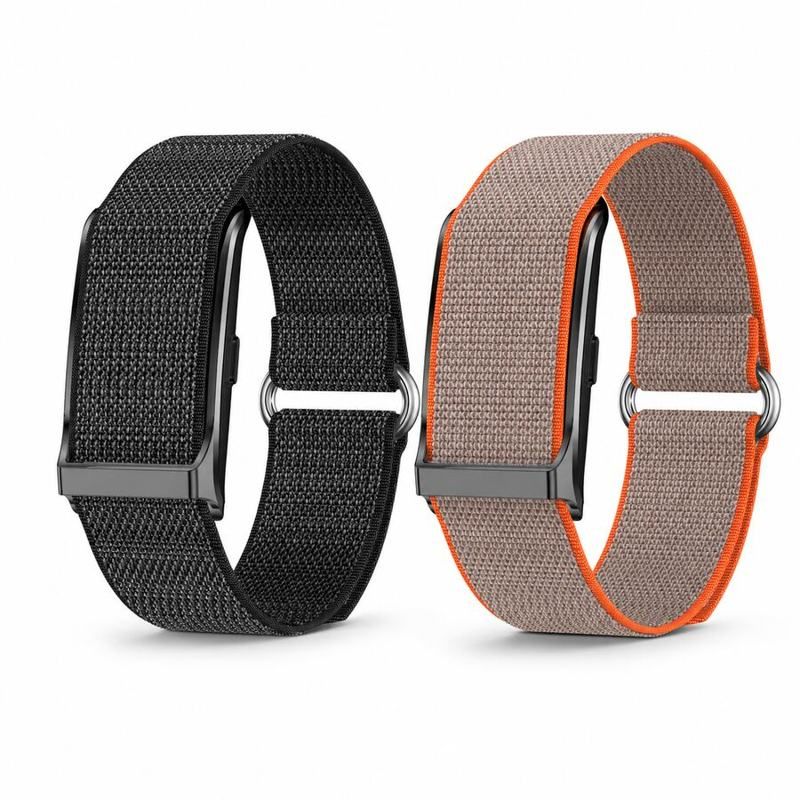
What our H59, DS05 and DS10 specifications actually say
The supplied specification sheets for H59, DS05 and DS10 list the same headline platform details:
| Item | Listed specification for all three models |
|---|---|
| Battery capacity | 150mAh |
| Main chipset | Realtek 8762ESF |
| Heart-rate sensor | VC30F-S |
| Companion app | QWatch Pro |
| General use | 20–30 days |
| Standby | 45–60 days |
These are specification-sheet figures, not the results of a new comparative test. The sheets reviewed for this article do not define the complete endurance test protocol. Standby is not a substitute for on-wrist usage with measurements, synchronization and notifications enabled.
Our factory owner reports personally wearing each of these three models for more than a month between charges in everyday use. That is a personal observation, not a controlled three-model study or a promise for every buyer. We do not have a confirmed, identical settings record for all three trials, so we have not converted that experience into a higher advertised runtime.
Read the energy budget, not just the capacity label
A useful first approximation is:
Runtime in hours ≈ usable battery capacity in mAh ÷ average battery current in mA.
For illustration only, assuming the entire rated 150mAh were usable, a 0.25mA average draw gives 600 hours, or 25 days. At 0.50mA, it gives 300 hours, or 12.5 days. These are arithmetic examples, not measurements of our products or a competitor's band.
A real result also depends on usable capacity, temperature, battery condition and the device's shutdown threshold. Ask the supplier how the capacity was specified and when its runtime test stops. A battery icon reaching zero, automatic shutdown and loss of reliable data recording are different endpoints.
Removing the screen leaves other power demands
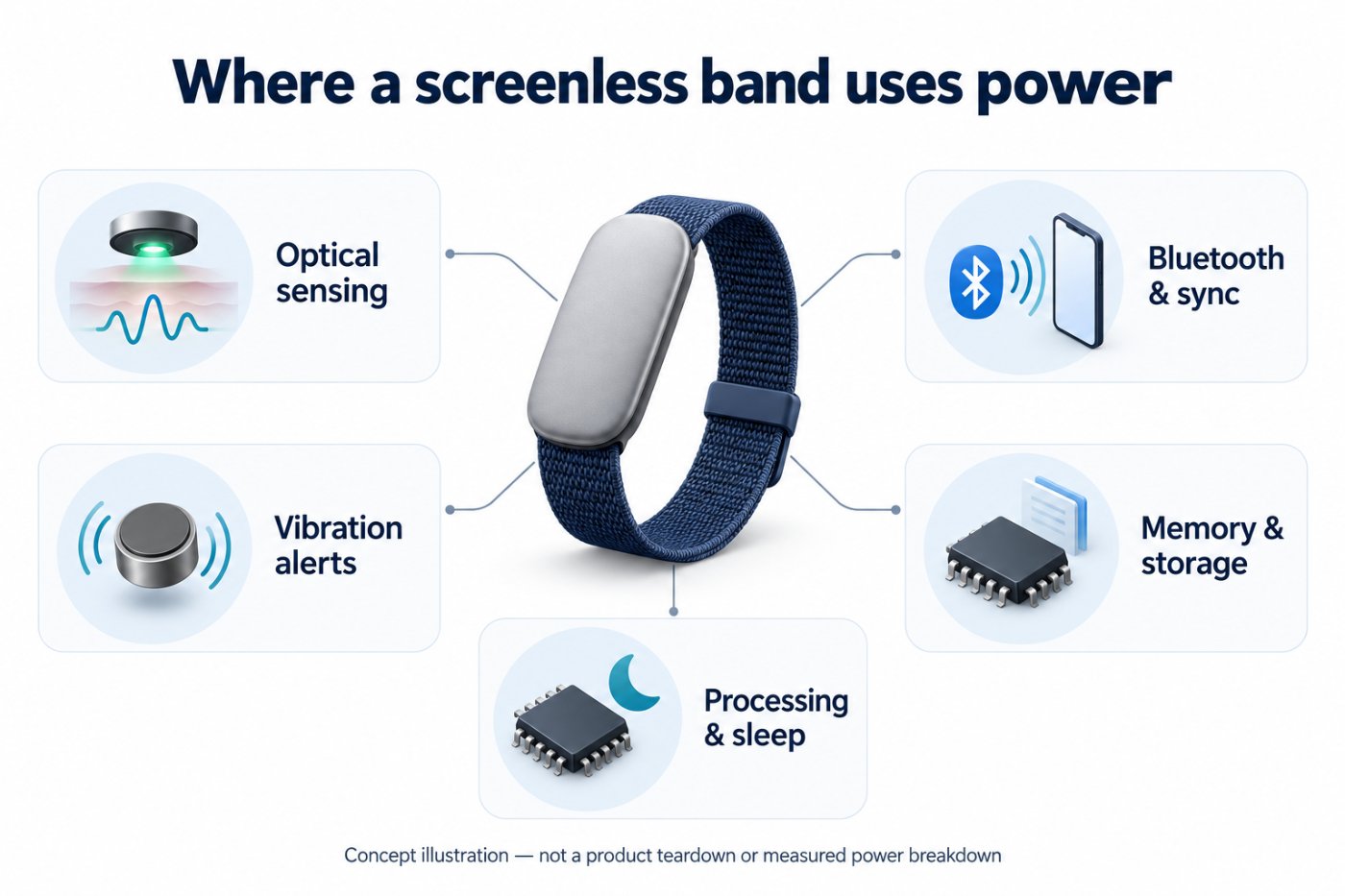
A screenless design removes display-related loads, but it still has sensing, processing, storage, communication and vibration work to do.
Optical measurements have a schedule
Optical heart-rate sensing uses light and a detector. Texas Instruments explains that LEDs are pulsed for short windows to reduce power consumption in a PPG system. The important procurement distinction is between how often a measurement session starts and the sampling activity within that session. A setting such as “every five minutes” does not tell you the session duration or LED configuration. Technical source: TI optical heart-rate monitoring brief.
Ask which measurements run automatically, which require a manual action and what changes in workout mode. Longer runtime obtained by disabling a required feature is not an equivalent product configuration.
Sleep must work across the board
Firmware should let hardware rest between useful tasks. Nordic's power-optimization guidance identifies active peripherals, unnecessary logging and external flash left awake as possible sources of avoidable consumption. Its examples concern Nordic hardware and software; they are not a diagnosis of our Realtek-based models. The transferable buying question is whether the supplier has measured the complete board during idle periods, not just quoted the main chip's low-power rating. Technical source: Nordic power-optimization recommendations.
External flash may support firmware, updates or stored records, depending on the design. Do not ask for it to be removed simply because a band has no screen. Ask what it does, when it wakes and whether its inactive state has been verified. We have not established that flash causes an endurance problem in any of these models.
The phone connection and alerts are part of the workload
Include synchronization, disconnected periods, reconnection and vibration notifications in the test profile. “Bluetooth enabled” alone is not a complete usage description. Ask for measured behavior in the connection states your customers will encounter, including times when the phone is out of range.
A same-condition sample test buyers can request
Agree on a written profile before comparing samples. Use more than one unit per model and report each result, including exceptions, rather than selecting the longest-lasting unit.
| Record before testing | What to make explicit |
|---|---|
| Sample identity | Model, hardware revision, firmware version, sample count and battery condition |
| Starting point | Charging method, full-charge indication and test start time |
| Phone and app | Phone model, operating system, app version and connection settings |
| Measurements | Enabled features, automatic intervals, manual measurements and workout duration |
| Notifications | Notification count, vibration settings and alarms |
| Connectivity | Synchronization frequency, disconnected time and reconnection behavior |
| Wearing conditions | Wearing hours, fit, removal periods and approximate temperature |
| Endpoint | Agreed stop condition, elapsed time and whether data remained available |
Run the ordinary-use profile first. If notifications or workouts matter to your audience, agree on a separate heavier-use profile. Keep standby results in a separate column. Do not merge the best outcome from one profile with the functions enabled in another.
Record both endurance and whether the expected data was collected. A longer result with missing measurements is not automatically the better buying result.
What to request before a production order
Ask the supplier for the test profile, individual sample results and the hardware and firmware versions that produced them. If the production firmware changes, confirm whether the endurance evidence still applies.
In our supply chain, we integrate and manufacture the finished bands, while our upstream solution partner supports the mainboard, app, firmware and algorithms. A useful technical answer may therefore require both teams. That is preferable to presenting an unverified explanation as an in-house finding.
For H59, DS05 or DS10, send us your intended usage profile so the sample discussion starts with the settings that matter to your market. For the broader product-category decision, see screenless bands versus smartwatches.
Choose the band whose documented performance matches your customer's workload. The capacity label is a starting point; a repeatable, relevant test is the evidence needed for your own product claim.
Sources and evidence boundaries
- Product figures: owner-supplied H59, DS05 and DS10 specification sheets, cross-checked against the linked product pages. No complete endurance test protocol was supplied.
- Factory experience: the owner's personal wear observations and description of the division of work with the solution partner. These are attributed experience, not independent laboratory results.
- Texas Instruments, optical heart-rate monitoring application brief SBAA564: general PPG measurement and pulsed-LED principles; not a VC30F-S test report.
- Nordic Semiconductor, power-optimization recommendations: general implementation checks; not proof of a defect or a measured saving in H59, DS05 or DS10.